UK Sinhala Poth Kade
The Buddhist Way of Life | For Grade 10 students | book #10 by Winitha Jinasena
The Buddhist Way of Life | For Grade 10 students | book #10 by Winitha Jinasena
Couldn't load pickup availability
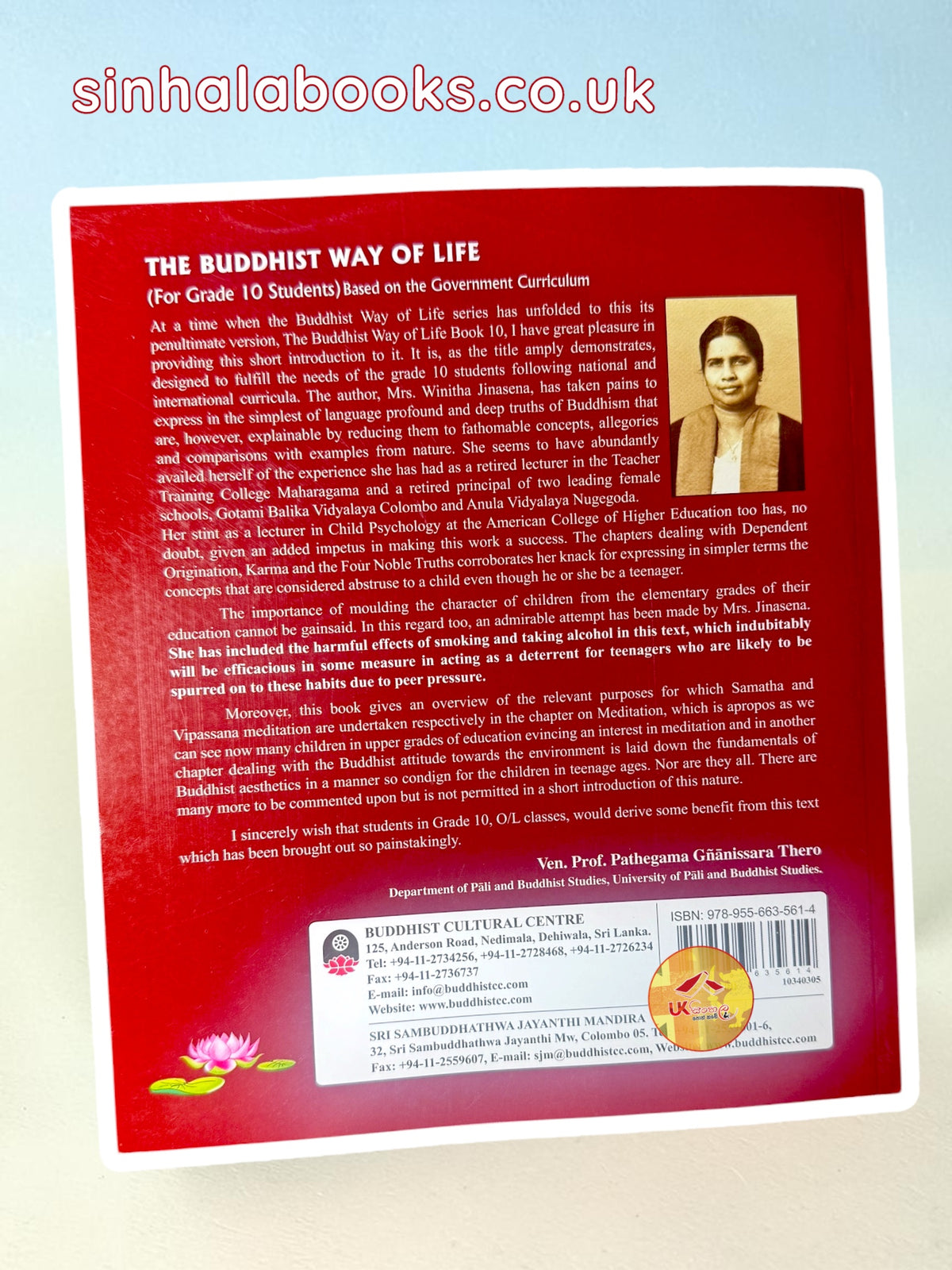
THE BUDDHIST WAY OF LIFE
(For Grade 10 Students) Based on the Government Curriculum
At a time when the Buddhist Way of Life series has unfolded to this its penultimate version, The Buddhist Way of Life Book 10, I have great pleasure in providing this short introduction to it. It is, as the title amply demonstrates, designed to fulfill the needs of the grade 10 students following national and international curricula. The author, Mrs. Winitha Jinasena, has taken pains to express in the simplest of language profound and deep truths of Buddhism that are, however, explainable by reducing them to fathomable concepts, allegories and comparisons with examples from nature. She seems to have abundantly availed herself of the experience she has had as a retired lecturer in the Teacher Training College Maharagama and a retired principal of two leading female schools, Gotami Balika Vidyalaya Colombo and Anula Vidyalaya Nugegoda. Her stint as a lecturer in Child Psychology at the American College of Higher Education too has, no doubt, given an added impetus in making this work a success. The chapters dealing with Dependent Origination, Karma and the Four Noble Truths corroborates her knack for expressing in simpler terms the concepts that are considered abstruse to a child even though he or she be a teenager.
The importance of moulding the character of children from the elementary grades of their education cannot be gainsaid. In this regard too, an admirable attempt has been made by Mrs. Jinasena. She has included the harmful effects of smoking and taking alcohol in this text, which indubitably will be efficacious in some measure in acting as a deterrent for teenagers who are likely to be spurred on to these habits due to peer pressure.
Moreover, this book gives an overview of the relevant purposes for which Samatha and Vipassana meditation are undertaken respectively in the chapter on Meditation, which is apropos as we can see now many children in upper grades of education evincing an interest in meditation and in another chapter dealing with the Buddhist attitude towards the environment is laid down the fundamentals of Buddhist aesthetics in a manner so condign for the children in teenage ages. Nor are they all. There are many more to be commented upon but is not permitted in a short introduction of this nature.
I sincerely wish that students in Grade 10, O/L classes, would derive some benefit from this text which has been brought out so painstakingly.
Ven. Prof. Pathegama Gñānissara Thero
Department of Pāli and Buddhist Studies, University of Pāli and Buddhist Studies.
Share